Key takeaways
- You do not need to start from scratch to significantly boost B2B landing page performance.
- Use your messaging to clearly state who your product is for and who it is not for, allowing the copy to disqualify poor-fit leads while keeping the path to conversion smooth for A+ prospects
- Strong alignment between your ads and landing pages keeps prospects engaged and reduces bounce rates.
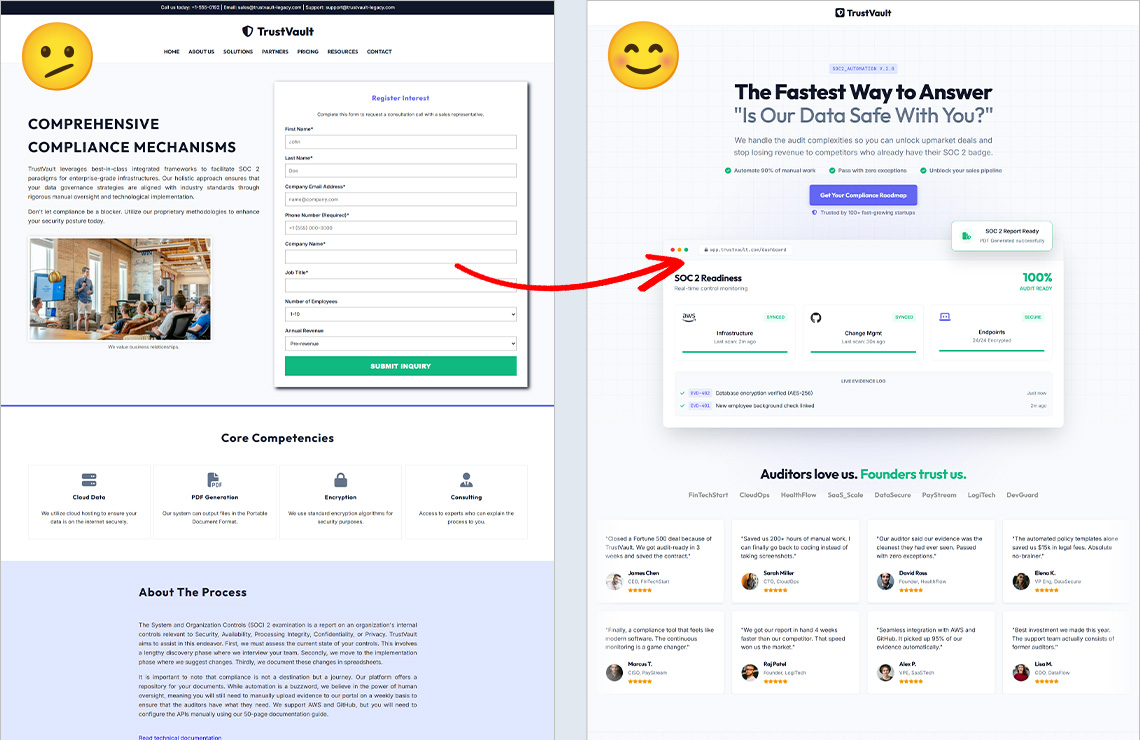
You do not need a total redesign to fix a landing page that is not converting. If your ads get clicks but your demo button is ignored, the problem is likely your messaging, not your brand.
You may have paid a branding agency to define your visual identity, but your prospects do not care about "data points connecting" or the color of your buttons.
They care about one thing: "Can this solve my problem right now?".
If your page is pretty but vague, you are losing money.
You can apply these strategic changes today without destroying what you have already built.
We will show you how to match your message to the user’s mindset, remove friction from your lead flow, and prioritize speed over design bloat. Follow this guide to sharpen your message and start turning expensive clicks into qualified leads.
You can apply these strategic changes right away to improve your conversion rate.
1. Don't Bait and Switch. Message Match.
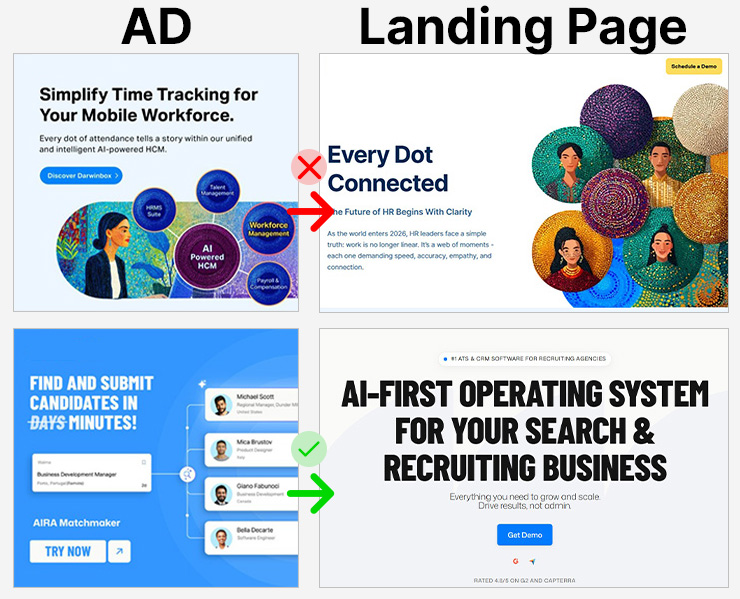 The landing page message must continue the ad's promise
Imagine you go to a restaurant because you saw a sign for their "Signature Spicy Burger." You sit down, order it, and the waiter brings you... a regular burger that is only vaguely spicy.
This is exactly what happens when your ad promises a specific outcome, but your landing page delivers a generic company overview. If your LinkedIn ad says "Cut Project Timelines by 50%," but your landing page headline says "The Leading Integrated Project Management Ecosystem," you have lost the narrative thread.
The Fix: Stop trying to be clever. Be consistent.
- The Clarity Test: Does your headline naturally continue the conversation started in the ad?
- The Continuity Rule: If the ad highlights a specific pain point (e.g., speed), the landing page header must confirm immediately that you are the solution to that specific pain.
- Focus on one Call to Action: Your ad and landing page should have the same call to action. Adding multiple choices forces your lead to do the mental math and hardens the decision process.
Our stance: We tell clients that the landing page isn't a new story; it’s the second chapter of the story the ad started.
2. Move Beyond "Logo Dumping" (Trust & Risk)
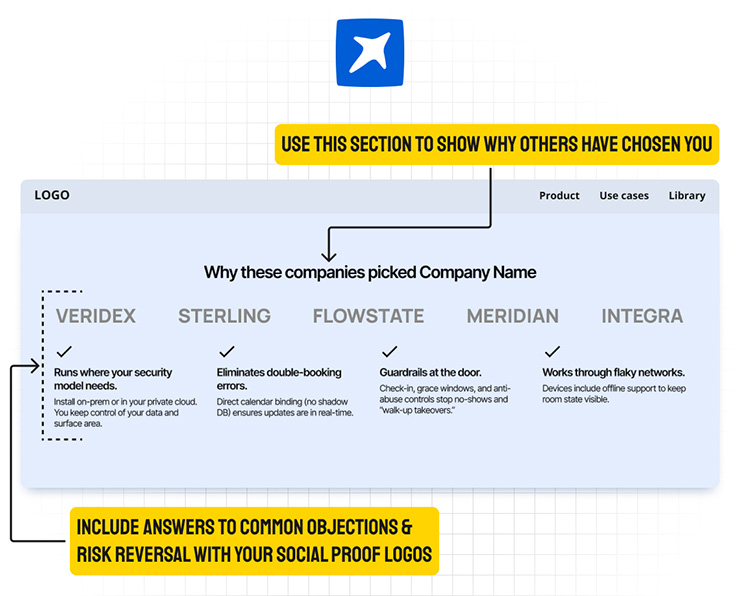 One of the ways we structure social proof and objection
handling
One of the ways we structure social proof and objection
handling
B2B buyers are risk managers. They aren't just buying software. They worry about wasted budget, implementation failure, and looking bad to their boss.
So, a strip of your client logos won’t really address their concerns. Furthermore, the fact that 99% of websites do this makes this section invisible to most visitors.
The Fix: Build "Evidence Blocks". Pair your logos with context. Don't just show the logo; add a review that cites specific data or answers a common objection.
3. Filter leads through your messaging, not through your form
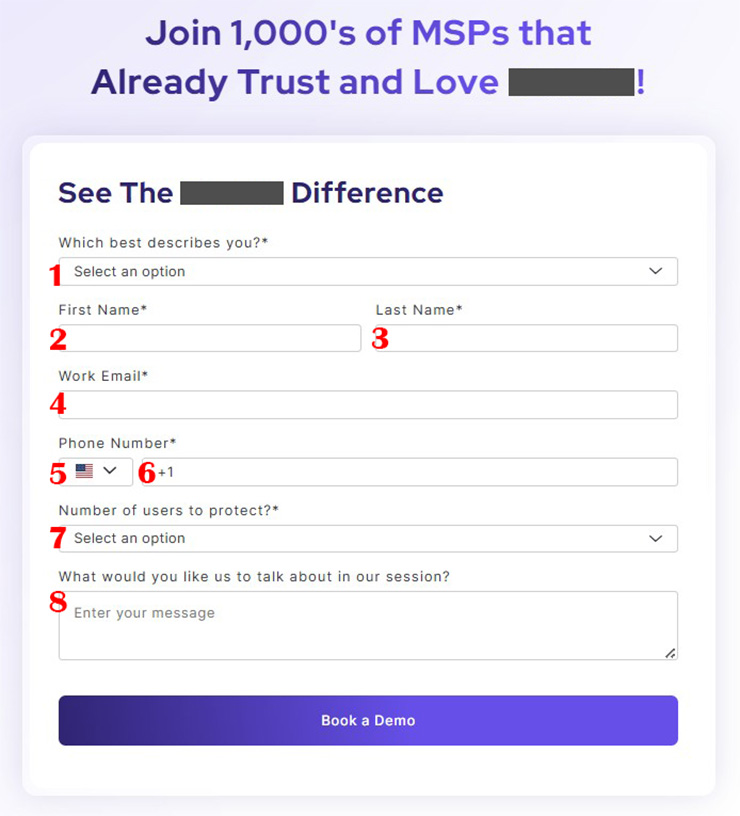 A form that requires 8 actions in order to submit
We often see forms with 6+ fields asking the user to define their role, company size, budget, and timeline. You are effectively asking the prospect to do your data entry.
We know the tension: Marketing wants volume (short forms), Sales wants quality (long forms). However, adding friction to the form usually just scares everyone away—good leads included.
The Fix: Don't use the form to force users into buckets—do that qualification on the page.
- Disqualify via Copy: Be clear about what your product does and who it is for and who it is not for.
- Paginate the form: If you absolutely need 6+ fields, break it into steps.
4. Match the Narrative to the User's Mindset
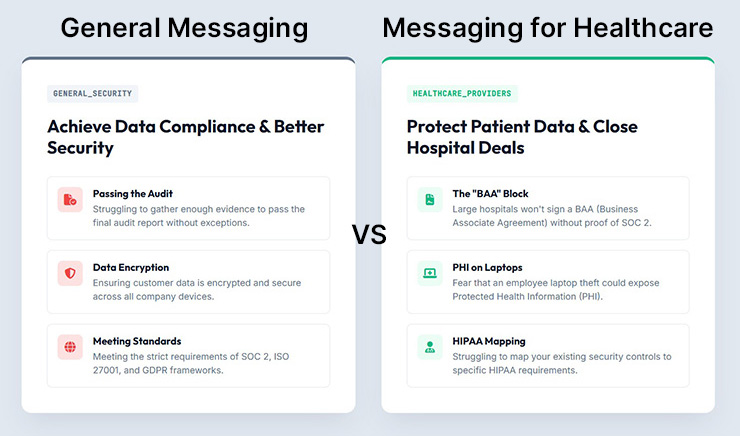 Comparison between general and audience specific messaging
Generic "one-size-fits-all" pages struggle to convert because they force the user to do the mental math.
If a user clicks an ad, they arrive with a specific context: their Industry (e.g., Healthcare) and their Stage of Awareness (e.g., "I have a problem" vs. "I need a specific tool").
If you send a cold lead from the Healthcare industry to a generic homepage full of technical specs, you're forcing them to piece together how your solution fixes their problem. But they don't have enough context to be able to make that decision.
The Fix: Align your page with the traffic source. Instead of writing a broad overview, mirror the mindset of the visitor.
- For Cold Traffic: Focus on the problem specific to their industry (e.g., "Stop losing patient data").
- For Warm Traffic: Focus on the solution and technical advantages (e.g., "The only HIPAA-compliant CRM").
When the landing page narrative completes the thought process started by the ad, trust increases, and conversion becomes natural.
5. Page Speed on Mobile (Why Overdesigning Hurts You)
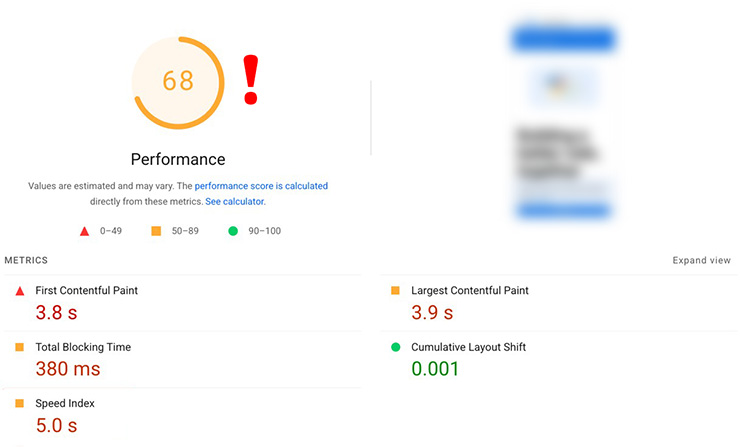 A mediocre loading speed negatively influences conversion
rates
A mediocre loading speed negatively influences conversion
rates
Here is a detail often overlooked: Your B2B buyer is likely continuing their research into your solution on their phone.
If your site is built on a bloated CMS with massive images and complex animations, it loads slowly. And in the landing page world, a slow website equals lower conversion rates.
The Fix:
- Text-First Design: On mobile, typography is the design. Reducing the use of images & emphasizing with typography makes sure your page loads fast and is easy to scan.
- Kill the Bloat: We advise clients to optimize images and use static versions of their animated graphics.
- The "Pure Code" Option: If your main corporate site is sluggish (looking at you, WordPress), we sometimes build landing pages in pure HTML/CSS. They live on your domain, but they load fast because they carry none of the baggage.
You Don't Need a Redesign. You Need Clarity.
At Whale of the Web, we believe that spending months and budget on a "visual refresh" is often a waste of time.
You don't need a new logo. You need a message that lands.
We specialize in creating & fixing B2B landing pages. We create messaging strategies, write persuasive & targeted copy, and build high-performance, well designed pages in 14 days or less.
Email Us to Get Your Video Assessment
Want to know if your page is good or could be performing better?
Send us your landing page URL and the ad that drives traffic to it. We will send you a video assessment of your page within 48 hours, highlighting exactly where you are losing leads and the things you can fix immediately.
contact@whaleoftheweb.comFAQ
Should I use my homepage or a dedicated landing page for my ads?
Use a dedicated landing page because homepages are too broad and force visitors to work too hard to find relevant information. A landing page speaks directly to the primary problem mentioned in your ad, which prevents prospects from leaving due to a lack of relevance.
Can I improve conversions without a total redesign?
Yes, focusing on clear messaging is more effective than a "visual refresh" because buyers care about solving an urgent pain, not the color of your buttons.
How does page speed affect my performance?
Slow loading speeds cause prospects to leave before they see your value. This creates a negative brand association and often leads visitors to abandon their search for a solution entirely.

About the Author
Andrei is the co-founder of Whale of the Web. He specializes in B2B website messaging and design. His work across the last 6 years focuses on B2B SaaS and Tech companies, helping them improve their online presence and lead generation through strategic website design.